Mahjong Night for Beginners: What You Need for Your First Game and How to Organise It
A mahjong evening works particularly well as a social gathering because the game gives four people something to focus on without demanding constant concentration or specialist equipment beyond a suitable set and a table. The main challenge for a first Mahjong Night is not learning every rule before anyone sits down; it is choosing one version of the game, preparing the essentials in advance and teaching only what players need for the first few hands. Mahjong has several established rulesets, including Japanese riichi, Chinese styles and American Mah Jongg, and they are not interchangeable in every detail. A relaxed first evening therefore starts with a clear decision about which rules everyone will follow, followed by a simple introduction to the tiles, the turn sequence and the basic idea of completing a hand.
Choosing a Mahjong Set and Rules for Your First Evening
Four players are ideal for a conventional mahjong game, so inviting exactly four people is the simplest arrangement for a first evening. A fifth guest can still work if the group is happy to rotate between hands, but adding more people usually means bringing a second set and creating another table. For a beginner group in Britain or Europe, Japanese riichi mahjong is a practical choice because English-language rules and reference material are widely available. Under the World Riichi Championship rules, a standard riichi set contains 136 playing tiles: four copies of each of 34 basic tiles. These consist of three numbered suits — characters, circles and bamboo — plus four winds and three dragons.
Not every mahjong box contains exactly the same pieces. Some sets have 144 tiles because they also include flowers and seasons, while others contain spare tiles, jokers or red-numbered tiles intended for particular rules. American Mah Jongg is more different still: it uses jokers, racks and an annually updated card showing the permitted hands. The National Mah Jongg League publishes a new card each year, including a 2026 edition. This is why buying a box simply marked “mahjong” and improvising the rules on the evening can create unnecessary confusion. Check what is inside the set first and decide which rules match it.
For a casual first game, there is no advantage in trying to combine several traditions. If you choose riichi, remove tiles that are not part of the rules you intend to use and keep a basic reference sheet near the table. If you choose a Chinese ruleset, use the tile selection and scoring system specified for that version. If your group specifically wants American Mah Jongg, everyone should have access to the current rules card rather than an old list copied from another year. Consistency matters more than complexity: four people following one simplified explanation will have a much easier evening than four people who have each watched a different tutorial.
What to Put on the Table Before the Guests Arrive
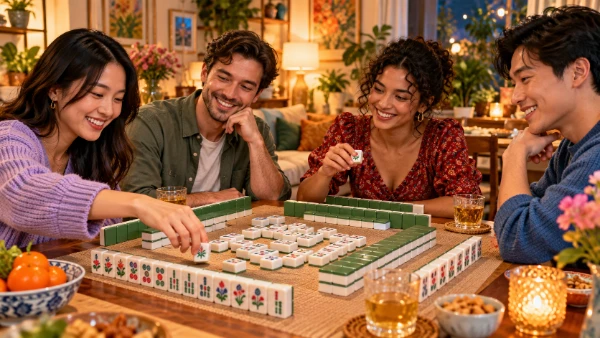
The essential equipment is pleasantly modest. You need one complete mahjong set, a stable table with enough room for four players and a chair on each side. A square table is particularly convenient because every player has similar access to the centre, although an ordinary dining table works perfectly well. A cloth, felt mat or purpose-made mahjong mat can reduce noise and stop hard tiles from sliding, but it is not compulsory. Good overhead lighting is more important. Players need to distinguish similar symbols quickly, especially the character suit and numbered bamboo tiles, so a dim room makes a first game harder than it needs to be.
Arrange the set before people arrive rather than opening the box for the first time in front of them. Count the tiles, separate anything that will not be used and confirm that four copies of every required tile are present. If the rules use score sticks, chips or counters, divide them into four starting sets in advance. A printed one-page guide showing the three suits, winds, dragons and basic combinations is also useful. New players should be able to glance at it during play instead of trying to remember unfamiliar names. For a social game, there is no need to turn the table into a tournament desk with extensive charts and paperwork.
Keep drinks on a side table when possible. Mahjong involves frequent reaching, drawing and discarding, and a full cup next to a wall of tiles is an obvious risk. Small bowls of dry snacks are easier to manage than greasy finger food because the tiles are handled continuously throughout the evening. Napkins, water and a place for phones and personal items also help keep the playing area clear. The objective is not to create a formal setting; it is to remove the little interruptions that can make the first lesson feel longer and more complicated than the game actually is.
How to Teach the First Mahjong Game Without Overloading Beginners
Start with the tiles rather than the scoring system. Show the group the three numbered suits and explain that each runs from one to nine. Then introduce the winds — East, South, West and North — followed by the three dragons. At this point players already know enough to sort a hand and recognise matching tiles. The broad objective in many traditional mahjong forms can then be explained in one sentence: players draw and discard tiles while trying to build a legal winning hand, commonly based on groups of three tiles together with a pair. There are important exceptions and additional requirements depending on the ruleset, but they do not all need to be taught in the opening five minutes.
The next step is the rhythm of a turn. A player normally begins with a hand of tiles, draws one tile and then discards one, so the hand continually changes as everyone tries to improve it. Show this physically with a few sample turns. New players tend to understand a sequence much faster when they see a tile move from the wall into a hand and another tile move into the discard area. Only after that demonstration should you explain calls such as taking another player’s discard to form a group. In riichi, terms such as chi, pon and kan are useful, but introducing every restriction attached to them before the first hand usually slows the evening down.
Scoring should come later. Riichi mahjong in particular has a detailed scoring structure involving yaku, han and fu, and a complete explanation can easily occupy more time than the first game itself. Beginners do need to understand that a structurally complete hand is not automatically a valid winning hand under riichi rules: it must contain at least one recognised yaku. For the first evening, keep a simple yaku reference sheet beside the table and concentrate on a few common examples rather than attempting to memorise the whole list. One experienced host can calculate points for the opening games while everyone else learns how hands are built.
A Simple Teaching Order for the Opening Round
A short practice hand is more useful than a long lecture. Begin by dealing the tiles and allow everyone a minute to arrange their hand into suits and honours. Explain that tiles can be kept upright and concealed from the other players, then identify the dealer and demonstrate how the wall supplies new tiles. For the first few turns, it is perfectly reasonable for players to keep their hands visible if the group is comfortable with it. Open hands make it easier to explain why one discard is useful, why another player might call a tile and how groups begin to take shape.
During this practice, let players ask questions as situations occur. Explain a sequence when someone actually has one, a triplet when two matching tiles appear in a hand and a pair when it becomes relevant. This creates a clearer connection between the rule and the tiles on the table. Avoid correcting every strategic decision. A beginner who discards a useful tile has still learned how a turn works, which is more important during the first hand than making the mathematically strongest choice. Mahjong strategy becomes interesting precisely because players gradually start seeing patterns that were invisible to them an hour earlier.
Once everyone can draw, assess a hand and discard without prompting, play a normal hand with concealed tiles. Keep the first session forgiving: allow questions, permit someone to reconsider an obvious accidental discard if nobody has acted on it and explain unfamiliar situations as they appear. Formal competition rules can be introduced later. If a rules dispute occurs, use the reference for the ruleset chosen at the start rather than deciding by majority vote. That habit prevents different house rules from quietly appearing during the evening and gives returning players a consistent game to learn.
Organising Mahjong Night as a Comfortable Social Evening
Allow more time than you would for an ordinary board game. A group of experienced mahjong players may play efficiently, but a first session contains explanations, questions and pauses while people read their tiles. Around three hours is a sensible window for an introductory evening, without promising that the group will complete a particular number of rounds. Set a start time that gives everyone at least half an hour to arrive, get a drink and learn the tiles before the first serious hand. Finishing at a sensible hour is better than forcing tired beginners through another round simply because the rules describe a longer match format.
The atmosphere should make conversation possible without turning every hand into a group debate. Background music can work at low volume, but television and loud playlists compete with explanations and make tile names harder to hear. Put the strongest or most experienced player where they can easily assist the others rather than treating that person as an opponent who must play at full competitive intensity. If everyone is new, appoint one person as the rules reader for the evening. That person does not need to know every answer beforehand; their role is simply to check the agreed reference when something unusual happens.
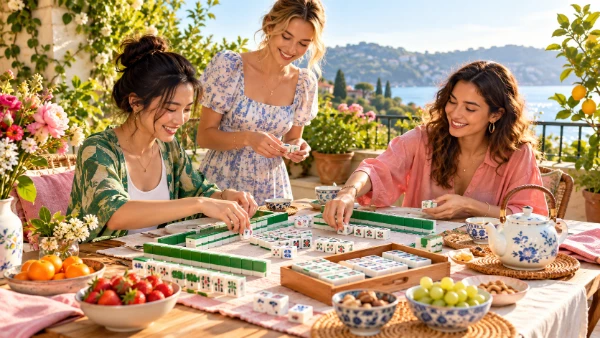
Food is easiest before the first game or during a planned break. Pizza, noodles and other full meals are better eaten away from the tiles, while fruit, biscuits or other low-mess snacks can be served between hands. Alcohol is a matter for the group, but a complicated new game generally becomes harder to teach if drinking becomes the main activity. Tea, coffee and water are useful throughout a longer session. Mahjong Night works best when the game is the reason people are gathered around the table but not a test that anyone has to pass.
Timing, Etiquette and Making the Next Game Easier
Basic table etiquette can be explained without making the evening formal. Players should discard clearly into the centre, avoid changing a discard after the next player has acted and give others enough time to see what has been played. Calls should be spoken clearly when the chosen rules require them. It is also good practice not to comment on another person’s concealed hand or reveal information that could influence a decision. These habits make the game easier to follow and become increasingly important as the group gains experience, yet they are simple enough to use from the first evening.
Do not measure the success of the night by how many people memorise the scoring table. A more useful sign is that each player finishes knowing the tile families, the basic turn sequence and roughly what they are trying to build. Take a photograph of the rules reference or send the same guide to everyone afterwards so they can use identical terminology before the next meeting. If the group enjoyed riichi, the World Riichi Championship provides English-language player materials such as a yaku list and scoring table, which makes it easier for newcomers to continue learning from a consistent rules source.
For a second Mahjong Night, keep most of the first evening’s setup unchanged and add only one or two new ideas. Players might learn a few more yaku, begin calculating simple scores themselves or talk about safer and riskier discards. This gradual approach is much more manageable than trying to master the full game at once. The appeal of mahjong is that the basic action of drawing one tile and discarding another is easy to understand, while the decisions around those actions become richer with experience. A well-organised first evening gives friends enough structure to play a genuine game and enough breathing room to want another one.