Adult Summer Camps in 2026: Sport, Creativity and Time Away on Adult Terms
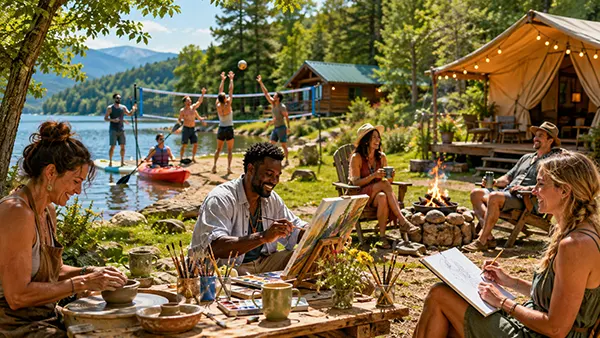
Summer camp is no longer a holiday format reserved for children, teenagers or families travelling together. In 2026, adults can choose from short residential weekends, activity-led breaks, creative retreats and longer stays designed specifically for grown-ups travelling alone, with friends or as part of a social group. The appeal is fairly straightforward: accommodation, activities and opportunities to meet people are brought together in one place, while participants remain free from the routines that shape a conventional family holiday. Some camps concentrate on outdoor sport and evening entertainment, others give most of their time to pottery, music or crafts, and some deliberately leave large parts of the day unstructured. The important distinction is that an adult camp is not simply a children’s camp with older guests. Age rules, accommodation, food, evening events and the pace of the timetable are usually designed around adult expectations. That makes the format particularly relevant to people who want a few days away without organising a family itinerary, a large friendship-group trip or a conventional resort stay.
What Adult Summer Camps Look Like in 2026
There is no single model for an adult summer camp in 2026. At the active end of the range, Camp Wildfire in Kent describes itself as an adults-only camp combining daytime adventure with evening entertainment. Its two 2026 summer weekends, scheduled for 28–31 August and 4–7 September, sold out, with tickets originally starting from £299. In the United States, Club Getaway in Connecticut runs separate adult weekends for guests aged 21 and over, with 2026 dates continuing into September and October. Camp No Counselors also uses a 21-plus rule and operates three-night adult camp events at locations in New York, California, Texas and Florida. These examples show that the modern adult camp is often a compact break lasting a long weekend rather than a traditional two-week summer stay.
Other organisers use the camp idea for a much quieter or more specialised type of holiday. CraftStudies in Vermont scheduled its 2026 Adult Summer Camp for 10–14 August and 17–21 August, combining familiar camp activities with structured craft tuition. Participants can choose a sampler format or spend concentrated time on subjects such as pottery, jewellery, upholstery or making jeans. Camp Château in France takes another approach: it runs all-inclusive sleep-away stays for adult women, with creative hobbies, local activities, relaxation and excursions forming part of the programme. This variety matters because the words “adult summer camp” can describe anything from a lively weekend with sports and music to several days centred on making things by hand.
The adults-only element also needs to be read carefully rather than assumed. Some events accept guests from 18, while others set the minimum age at 21, particularly where alcohol and late-night entertainment form a substantial part of the schedule. Certain camps are aimed at a defined community or demographic, while others attract a broad mixture of solo travellers, couples and friendship groups. A prospective guest should therefore check the actual admission policy rather than relying on the word “adult” in the event name. It is equally useful to look at the daily timetable. Two camps can charge a similar price and occupy similar countryside settings but offer very different experiences if one schedules activities throughout the day and the other treats participation as largely optional.
Why the Adults-Only Format Feels Different from a Family Holiday
The main practical difference is control over time. Family trips usually involve compromise between different ages, sleeping patterns, meal preferences and energy levels. An adults-only camp removes much of that coordination. Someone can spend the morning kayaking, join a craft session after lunch and sit by a fire in the evening without also arranging children’s activities or adjusting the day around school-age routines. That independence does not mean every minute has to be busy. In a well-designed camp, choosing not to join an activity should be as normal as taking part. For adults whose working weeks are already governed by appointments, a timetable with genuine gaps may be more attractive than a programme offering the maximum possible number of sessions.
The social side is also different from a standard hotel holiday. Camp activities give strangers an immediate shared task, so conversation does not depend entirely on approaching someone at a bar or restaurant. A team game, craft table, group hike or informal evening event provides a reason for people to interact. This can suit solo travellers who want company without committing to a fully escorted tour. It can also work for friends whose usual trips have become repetitive. The setting creates opportunities to spend time together while allowing each person to select separate activities during the day. That balance between shared and individual time is one of the more useful features of the format.
Adult-only should not automatically be interpreted as party-focused. Some camps do include bars, DJs, themed nights and alcohol, but others place far greater emphasis on creativity, nature, food or quiet social time. Even within a single camp, the evening programme may be optional. Anyone who wants early nights, limited alcohol or a calmer environment should check where accommodation sits in relation to entertainment areas and how late organised events continue. Conversely, someone expecting an active social weekend should not assume a craft retreat or wellness-led stay will provide nightlife. The adult camp category has become broad enough that the name alone says relatively little about how a weekend will actually feel.
Sport, Creativity and Rest: Three Ways to Shape a Camp Break
Sport and outdoor activity remain central to many adult camps. Camp Wildfire’s 2026 activity selection includes options such as stand-up paddleboarding, raft building, flying trapeze, circus aerial sessions, quad biking and mini golf alongside less athletic choices. Club Getaway advertises more than 80 activities across water sports, fitness, yoga, hiking, adventure facilities and social sessions. A large menu is useful because it allows participants to adjust the level of physical effort across the weekend. It is rarely sensible to book the most strenuous option in every available slot. Weather, unfamiliar movement and a late evening can make the second day feel considerably harder than the first, particularly for someone whose normal week contains little outdoor exercise.
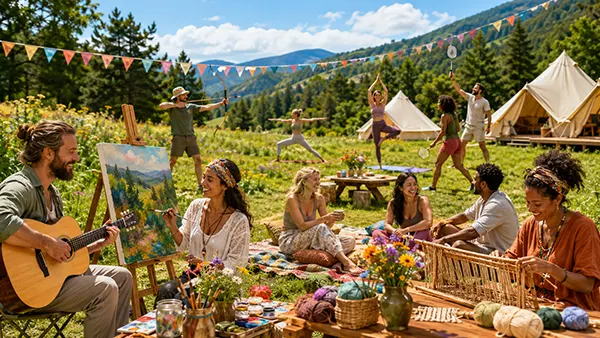
Creative camps provide a different type of concentration. Instead of moving rapidly between activities, participants may spend several hours learning one process and leave with something tangible they have made. CraftStudies’ 2026 programme is a clear example: its intensive options include pottery, jewellery, upholstery and jeans making, while its sampler week allows participants to work across several craft areas. Camp Wildfire also mixes physical sessions with activities such as letterpress work, creative writing and wood whittling. The important point is that creativity does not have to mean professional-level art training. Many adult camp sessions are structured around participation, practical guidance and the pleasure of doing something with the hands rather than achieving a formal qualification.
Rest is the third part of the equation, but it is the easiest one to overlook when comparing long activity lists. A holiday can offer dozens of appealing choices and still leave a guest more tired than when they arrived. Adults looking for genuine downtime should check whether activities are compulsory, how far accommodation is from dining and session areas, when breakfast starts, and whether there are places to sit quietly during the day. Camp Château, for example, combines organised electives and excursions with a format that also emphasises relaxation and restorative hobbies. That is quite different from a high-energy weekend where the value comes largely from fitting as much as possible into two or three days.
How to Choose the Right Level of Activity
A useful way to plan an adult camp is to decide on one priority before looking at the timetable. If the main reason for travelling is physical activity, choose one or two sessions that would be difficult to arrange at home and build the rest of the day around them. Someone interested in paddleboarding or climbing does not also need to fill every remaining hour with competitive sport. The same principle works for creative breaks. A substantial pottery or textile workshop may provide more value than repeatedly moving between short introductory sessions simply because they are available. Choice is valuable only when it supports the reason for taking the trip.
It also helps to distinguish between activities that require advance booking and those that can be joined spontaneously. Camp Wildfire, for example, uses an activity-credit system for many sessions while also providing some drop-in choices. Other camps may ask guests to select workshops well before arrival because equipment, instructors or studio capacity is limited. This changes how flexible the break will feel. A heavily pre-booked schedule offers certainty but leaves less room for changing plans after a poor night’s sleep or an unexpectedly demanding morning. A mixture of reserved priorities and unscheduled time is often a more comfortable arrangement.
Accommodation should be considered part of activity planning rather than a separate booking detail. Shared cabins can strengthen the social side of camp, but they also mean adapting to other people’s sleeping habits and morning routines. Tent camping creates a very different level of comfort from a private room, particularly during wet or hot weather. Before paying, check what bedding is supplied, how many people share a room, whether toilets and showers are private or communal, and whether quieter accommodation can be requested. Someone who needs good sleep to enjoy sport the next day may gain more from better accommodation than from adding another paid activity.
Costs, Booking and Practical Checks Before You Go
Adult camps vary substantially in price because the package can include very different things. For its 2026 season, Camp Wildfire listed summer tickets from £299, although both summer weekends had sold out by August. Club Getaway listed several 2026 adult weekends from $569, with accommodation, meals and a broad activity programme forming part of the stay. An apparently higher price can therefore be reasonable if it covers meals and most activities, while a cheaper ticket may require separate spending on accommodation, food, equipment or specific sessions. The useful comparison is the total likely cost of the trip, not the headline ticket alone.
Before booking, read the inclusions and exclusions in detail. Meals may be included but drinks may not be. Equipment for an activity may be supplied, while craft materials can carry a separate charge. Airport transfers, local transport, specialist excursions, spa treatments or upgraded accommodation may sit outside the standard package. Travel to the camp is another significant item, especially for rural locations. International visitors also need to account for flights or trains, local transfers and appropriate travel insurance. A five-night camp can look simple when advertised as one package, yet the actual holiday budget may be considerably higher once the journey and optional spending are added.
Age rules, accessibility and personal requirements should be checked at the same stage as the price. Club Getaway and Camp No Counselors specify a minimum age of 21 for their adult camp experiences, while other events use different thresholds. Guests with mobility requirements should look at the terrain, distances between facilities and the accessibility of sleeping and washing areas rather than assuming a countryside venue will be straightforward to navigate. Dietary needs should also be confirmed directly. Similar care is sensible for medication storage, allergies or any condition affected by heat, prolonged activity or shared accommodation. These checks are ordinary holiday planning, but camp settings can make them more important because facilities may be spread across a large rural site.
Matching a Camp to the Reason You Actually Want to Go
For an activity-led break, the strongest choice is usually a camp where the sport you genuinely want to do occupies a central place in the schedule rather than appearing as one item among dozens. Check how long sessions last, what happens in poor weather and whether instruction is suitable for your current ability. A person interested mainly in water sports may gain little from paying for an event whose biggest attractions are evening performances. In the same way, someone wanting structured creative time should look for named tutors, proper workshop spaces and enough uninterrupted session time to complete meaningful work rather than simply counting the number of crafts on offer.
For a social break, look at how the organisers handle solo guests, room allocation, shared meals and group activities. The ideal programme creates natural opportunities to meet people without requiring constant participation. Evening entertainment can be useful, but it should not be the only mechanism for social contact, especially for people who do not drink or prefer earlier nights. Shared daytime activities usually provide an easier setting for conversation. It is also worth checking the approximate scale of the event. A large festival-style camp can provide enormous choice, while a smaller residential group may make repeated contact with the same people more likely. Neither is inherently better; they suit different expectations.
For someone primarily seeking rest, the best adult camp may be the one with the fewest obligations rather than the longest list of attractions. Look for flexible participation, comfortable sleeping arrangements, access to quiet outdoor space and enough time between meals and scheduled sessions to do nothing at all. Adult summer camps in 2026 cover a wide enough range that travellers do not need to accept the traditional image of constant team games and communal routines. Sport can be the focus, creativity can provide structure, or both can sit around long periods of unplanned time. The most suitable choice is the one whose real daily rhythm matches the break a person needs, not the one with the largest activity count or the busiest timetable.